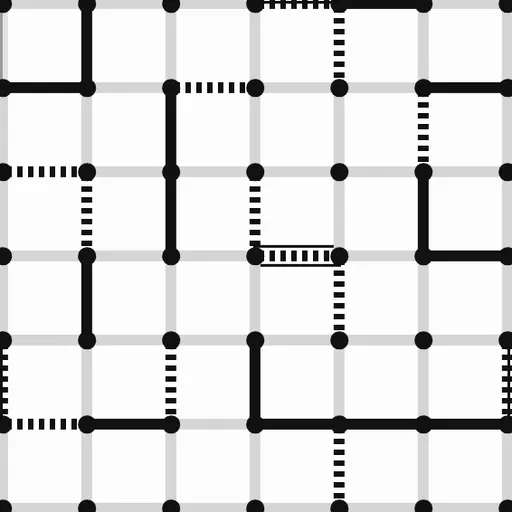

Dots and Boxes is the pencil-and-paper classic that many people first played in the margins of a notebook. This version, from Christopher Müller’s open-source PaperGames collection, shows a crisp black-and-white grid of dots. Two players take turns drawing short lines, and whoever closes a square keeps it. It looks simple, but the endgame rewards real planning.
The Goal
Own more boxes than your opponent when every line has been drawn. Each completed box is marked with a cross for Player 1 or a circle for Player 2. A tie in box count ends the game as a draw.
How a Round Plays Out
- Choose a grid: 4x4, 5x5, 6x6 or 8x8 boxes. The 6x6 grid is the default.
- Player 1 always draws first.
- On a turn, draw one horizontal or vertical line between two neighboring dots. Lines already on the board cannot be reused.
- If your line completes the fourth side of any box, you claim it and draw again.
- The turn passes as soon as you draw a line that closes nothing.
Against the computer you can take either seat, and Undo steps back through earlier moves. Player 1 draws solid lines and Player 2 draws dotted ones, so you can always tell who drew what.
Keys and Buttons for Dots and Boxes
| What you do | ⌨ Keyboard | 🖱 Mouse | 👆 Touch |
|---|---|---|---|
| Draw a line | Arrow keys to reach a line, Enter to draw it | Click the gap between two neighboring dots | Tap the gap between two neighboring dots |
| Start a game against the computer | — | Click "vs Computer", pick Player 1 or 2, a level and a grid size, then click "New game" | Tap "vs Computer", pick Player 1 or 2, a level and a grid size, then tap "New game" |
| Play a friend on one screen | — | Click "2 Player (local)" | Tap "2 Player (local)" |
| Take back a move | — | Click "Undo" | Tap "Undo" |
| Open settings | — | Click "Settings" | Tap "Settings" |
Winning Strategies
- Never draw a third side carelessly. Any box left with three sides is a free gift to the next player.
- Play safe lines early. While you can, draw lines that leave every box with two sides or fewer.
- Think in chains. A row of boxes that each have two sides acts as one long chain, and the player forced to open it usually loses all of it.
- Give away the smallest chain. When no safe line remains, open the shortest group so your opponent scores as little as possible.
- Count chains before the end. On big grids the last few chains decide the winner, so keep track of their number and length.
Common Mistakes
- Grabbing every box offered without checking whether it forces you to open a long chain next.
- Playing fast in the middle game and running out of safe lines before your opponent does.
Who Should Play It
Dots and Boxes is great for players who like short games with a hidden layer of strategy. If you enjoy classic paper games, grid strategy puzzles or quick matches against a friend, it is easy to learn and hard to master.
Played and checked by the KBHX Games team · updated