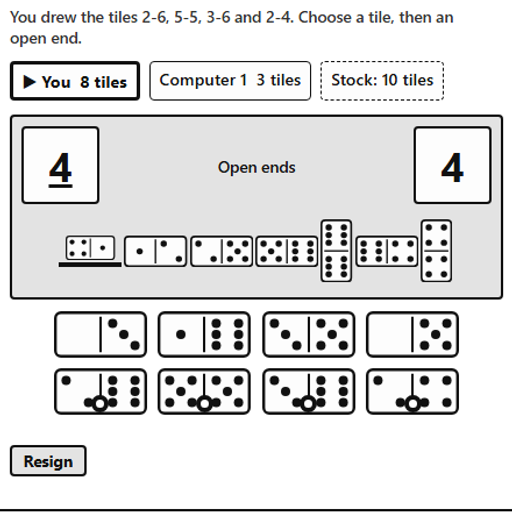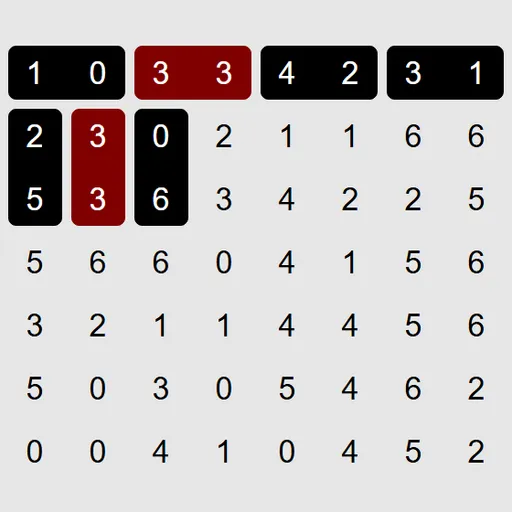
Dominosa Domino Logic hands you the trace of a domino layout. Someone packed a complete set into a rectangle, wrote down the number on every half, then took the tiles away. Only the numbers remain. You put the dominoes back so that each pair turns up exactly once. It is Dominosa from Simon Tatham’s Portable Puzzle Collection, a puzzle often credited to O. S. Adler.
The Goal
Cover every square of the grid with dominoes, with no pair repeated. The standard puzzle uses values 0 to 6. A full set has one domino for each pair, doubles included, which makes 28 tiles on an 8 by 7 grid. Each domino covers two squares that touch side by side or one above the other.
Rules Explained
- Click the gap between two neighboring numbers to lay a domino across them.
- Click the same domino again to remove it.
- A new domino that overlaps old ones pushes them off.
- Right-click a gap to draw a short line, a private note that no domino belongs there.
- Press a number key to light up every copy of that number.
The puzzle is solved when all squares are covered and every pair is unique. Repeated pairs turn red, so errors stand out. The Type menu offers smaller and larger sets plus four difficulty levels.
Keys and Buttons for Dominosa Domino Logic
| What you do | ⌨ Keyboard | 🖱 Mouse | 👆 Touch |
|---|---|---|---|
| Place or remove a domino | Arrow keys to a spot between two numbers, then Enter | Left-click between two neighboring numbers | Tap between two neighboring numbers |
| Draw or erase a "no domino here" line | Space | Right-click between two numbers | Press and hold between two numbers |
| Highlight every copy of a number | Type the number | Right-click on the number | Press and hold on the number |
| Undo, redo, new puzzle | U / R / N | Undo move, Redo move and New game buttons | Undo move, Redo move and New game buttons |
Winning Strategies
- Track down rare pairs. Choose a pair like 2-5 and find every spot it could sit. If only one exists, that domino is certain.
- Look for trapped squares. A square fenced in by edges and placed tiles can only join its one free neighbor.
- Rule out used pairs. After placing a pair, draw note lines across every other place it could have gone.
- Check the doubles. Two equal numbers side by side may be the only home for that double.
- Highlight two numbers at once. Lighting up both halves of a pair shows its possible spots quickly.
Handy Details
- Presets run from tiny sets with numbers up to 3 to large ones with numbers up to 9.
- Undo and redo are unlimited, so trial and error is safe.
- An Ambiguous mode exists for puzzles that may have more than one answer.
Who Should Play It
Dominosa suits logic fans who like pure deduction with no guessing. If you enjoy number placement puzzles or grid logic games where each step follows from the last, this is a satisfying, quiet challenge.
Played and checked by the KBHX Games team · updated