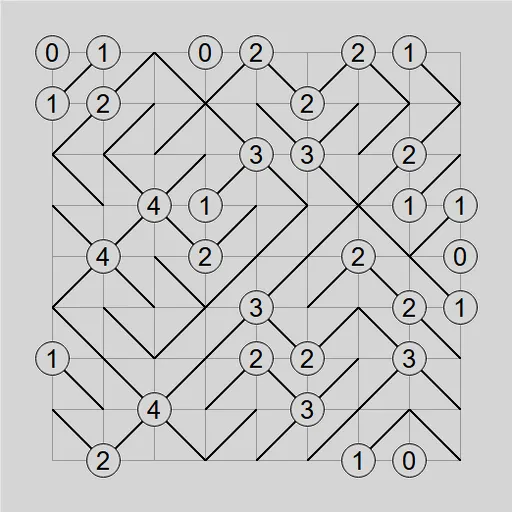
Slant Diagonals is a quiet pen-and-paper style logic puzzle where your only tool is a slash. You tilt one line in each cell, follow the numbered corners, and make sure no path ever circles back on itself. It comes from Simon Tatham’s well-known puzzle set, and it rewards patient, step-by-step thinking over guessing.
The Goal
Your job is to give every cell a diagonal so the whole board is full. Some grid corners carry a small circled number. That number says how many slashes must touch that exact point. On top of that, the finished drawing can’t contain a closed shape of any size. Every line you draw has to connect, sooner or later, to the outside border.
How a Round Plays Out
You choose a preset, such as 5x5, 8x8 or 12x10, at Easy or Hard. The board opens empty except for the clues.
- Look at a clue and the up to four cells around it.
- Decide which cells must lean toward the point and which must lean away.
- Place those lines. A left click draws a backslash, a right click draws a forward slash, and clicking again cycles through the options.
- Check the clues at both ends of each new line, since one placement often settles a neighbor.
If you close a loop or make a clue impossible, the game paints the problem in a warning color. Once every cell is filled correctly, the board flashes.
Keys and Buttons for Slant Diagonals
| What you do | ⌨ Keyboard | 🖱 Mouse | 👆 Touch |
|---|---|---|---|
| Place or cycle a \ line | Arrow keys to move, then Enter | Left-click a square | Tap a square with Tap set to "\ first" |
| Place or cycle a / line | Space | Right-click a square | Press and hold, or set Tap to "/ first" and tap |
| Set a square to one direction directly / empty it | Type / or \ / Backspace | — | — |
| New game, undo, redo | N, U, R | Menu buttons above the grid | Menu buttons above the grid |
Winning Strategies
- Clear the forced clues first. Zeros, fours and border clues often leave only one choice, so fill them before anything else.
- Count what is left. When a clue already has its full count of touching lines, every other cell around it must tilt the other way.
- Spot three-quarter diamonds. If three cells already outline most of a small diamond, the fourth has to break it.
- Follow chains to the edge. Trace long paths and ask whether they could still reach the border. A path trapped inside will turn into a loop.
- Use undo freely. If a guess goes wrong, step back instead of erasing cells one by one.
Handy Details
- On a phone, a tap cycles a cell and a long press starts from the other slash. A switch under the grid flips which line a tap places.
- Keyboard players can type / or \ directly and use N, U and R for new game, undo and redo.
- There is a Solve option if you want to see a finished board.
Who Should Play It
This one suits players who like slow, tidy logic and the click of a rule falling into place. If you enjoy number-placement grids or loop-drawing puzzles, you will feel at home here.
Played and checked by the KBHX Games team · updated