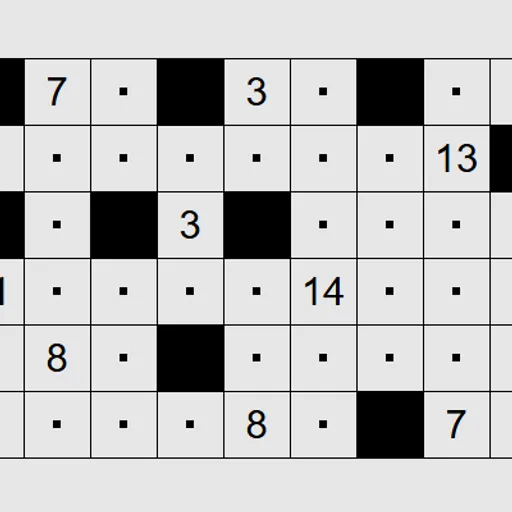
Range Shading Puzzle is a black-and-white logic grid built around what each number can see. You decide which empty squares turn black, and every clue must end up with an exact view. There is no guessing in a well-made grid, so each solved board feels earned. It is Range by Jonas Kölker from Simon Tatham’s Portable Puzzle Collection, a type also known in Japan as Kurodoko.
The Goal
Shade cells until all four rules hold at the same moment. A numbered cell never turns black. Black cells never share an edge, though they may touch at a corner. All white cells form one connected region. And every number equals the count of white cells it sees in straight lines, itself included. The grid flashes when you finish. Sizes run from 9 by 6 up to 16 by 11.
Rules Explained
- Look at a clue. It “sees” along its row and column until a black cell or the board edge stops it.
- Add up every white cell in those four arms, plus the clue cell.
- If the total is too high, something along those arms must become black.
- If the total could never reach the number, more cells must stay white.
- Left-click shades a cell, and right-click drops a dot to mark a cell you know is white. Clicking again cycles black, dot and empty.
For example, a 4 in a corner sees itself plus three more cells, split between its row and its column.
Keys and Buttons for Range Shading Puzzle
| What you do | ⌨ Keyboard | 🖱 Mouse | 👆 Touch |
|---|---|---|---|
| Shade a square black (repeat to cycle) | Arrow keys to move, then Enter | Left-click | Tap with Tap set to Shade black |
| Mark a square with a dot as surely white (repeat to cycle) | Space | Right-click | Press and hold, or set Tap to Dot and tap |
| Dot every square you pass over | Shift + arrow keys | — | — |
| New game, undo, redo | N, U, R | Menu buttons above the grid | Menu buttons above the grid |
Winning Strategies
- Measure the maximum view. If a number’s full row and column together equal its value, every cell in them is white.
- Dot around each black cell. Neighbors of a black cell must be white, so mark all four right after shading.
- Lean on small clues. A 2 sees only one other cell, so three of its sides must be black or the edge.
- Guard connectivity. Any black cell that would seal off a pocket of white is wrong, especially near edges.
- Lay dot trails fast. Shift plus an arrow key drags a line of dots across cells you have proved white.
Common Mistakes
- Forgetting to count the clue cell itself.
- Placing two black cells side by side, which is never allowed.
- Shading a cell that cuts the white area into two islands.
Who Should Play It
This is for logic fans who enjoy pure deduction with pen-and-paper roots. If you like number-shading grids or other logic puzzles from the same family, Range adds a fresh line-of-sight twist.
Played and checked by the KBHX Games team · updated