Peg Solitaire is a quiet one-player puzzle that has been played on wooden boards for centuries. All but one hole starts full, and each move removes a peg. The rules take a minute to learn, but finishing with a single peg takes real planning, which is why it stays fun long after the first try.
The Goal
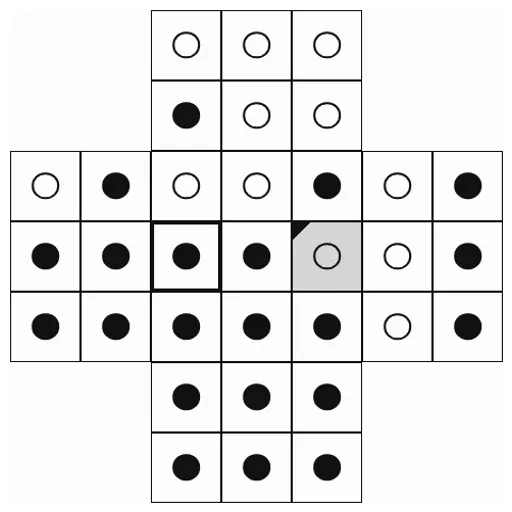
Your job is to clear the board until only one peg remains. You can choose from six layouts: the English cross with 33 holes, the 37-hole European board, a 45-hole German cross dated to 1779, a 6 by 6 square, a 41-hole diamond and a small 15-hole triangle. Every board’s starting gap has been checked so that a one-peg finish is possible.
The last peg can sit anywhere. Landing it in the center is a tougher challenge you can set for yourself, but the game counts any lone survivor as a win.
How a Round Plays Out
- Choose a peg. The empty holes it can reach light up.
- Pick one of those holes. It must be two spaces away in a straight line, with a peg in the middle.
- Your peg hops over, and the middle peg leaves the board.
- A counter above the board updates with the pegs left.
Play continues until no legal jump exists. If one peg remains, you solved it. If not, the game tells you the count, and you can step back with Undo as many times as you want or pick New game. On the European board the first gap sits just above the center, because a center start can’t be solved there.
Keys and Buttons for Peg Solitaire
| What you do | ⌨ Keyboard | 🖱 Mouse | 👆 Touch |
|---|---|---|---|
| Select a peg | Tab to the peg (arrow keys move across the board), then Enter | Click the peg | Tap the peg |
| Jump into a hole | Move to the marked empty hole, then Enter | Click a marked empty hole two spaces away | Tap a marked empty hole two spaces away |
| Take back a jump | — | Click "Undo" | Tap "Undo" |
| Change board or restart | — | Choose a board, then click "New game" | Choose a board, then tap "New game" |
Winning Strategies
- Work toward the middle. Pegs near the center have more partners to jump with, so pull the action inward instead of out to the rim.
- Empty an arm completely. On cross-shaped boards, finish one wing before touching the next, so you don’t leave scattered leftovers.
- Watch for loners. A peg with no neighbor can never move or be taken. Before each jump, check whether it cuts someone off.
- Learn the three-peg sweep. A short sequence that removes a line of three while keeping the rest of the group linked shows up again and again.
- Treat Undo as a tool. When a dead end appears, rewind several moves and try a new order rather than starting over.
Common Mistakes
- Jumping toward the edges early, which leaves corner pegs stranded later.
- Clearing the center too fast, so outer pegs have nothing left to jump over.
- Rushing the last ten pegs. That is where most games are lost, so slow down there.
Who Should Play It
This one fits patient thinkers who enjoy a calm puzzle with no timer and no luck. If you like tile-matching solitaire or sliding block puzzles, the clean, step-by-step logic here will feel familiar.
Played and checked by the KBHX Games team · updated