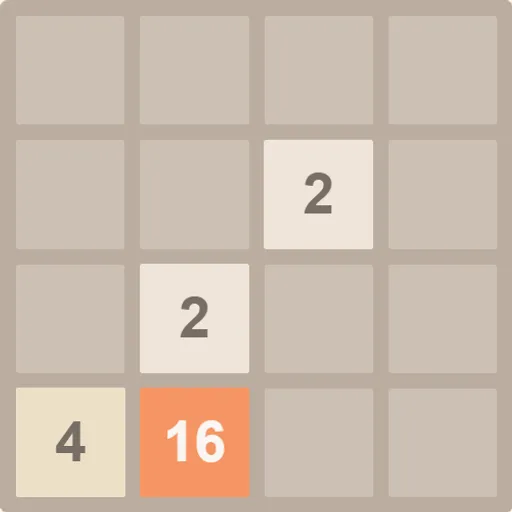
2048 asks you to build one big number out of many small ones. You push every tile on a sixteen-square grid in the same direction, and equal numbers fuse together. It takes seconds to learn, yet a single careless push can jam the board. That mix of easy rules and real planning is why so many people keep coming back to it.
The Goal
You start with two tiles, each showing a 2 or a 4. Your target is a tile worth 2048, which takes many rounds of doubling. Along the way, your score grows by the value of each new tile you form. A fresh 128, for example, is worth 128 points.
How a Round Plays Out
Choose a direction. All tiles travel that way until they hit a wall or another tile. When two equal tiles meet, they become one tile with double the value.
If the move changed anything, a new tile drops into a random open square. It is most often a 2. If nothing moved, no tile appears, so a dead swipe costs you nothing but time.
The run is over when all sixteen squares hold a tile and no two neighbors match. Reaching 2048 shows a win message. You can stop there or press “Keep going” and aim for 4096.
Keys and Buttons for 2048
| What you do | ⌨ Keyboard | 🖱 Mouse | 👆 Touch |
|---|---|---|---|
| Slide all tiles | Arrow keys, W A S D, or H J K L | — | Swipe up, down, left or right |
| Start a new game | R | Click "New Game" | Tap "New Game" |
| Continue after reaching 2048 | — | Click "Keep going" | Tap "Keep going" |
Winning Strategies
- Anchor one corner. Choose a corner for your largest tile and plan every swipe around keeping it there.
- Limit your directions. With a bottom-left anchor, favor Down and Left. Use Right sparingly and treat Up as a last resort.
- Line up a staircase. Arrange the edge row from high to low, such as 512, 256, 128, 64. A single merge can then roll down the line.
- Lock the anchor row. Once your edge row has no gaps, sideways swipes cannot shift the big tile out of place.
- Clean up stray 2s. A tiny tile stuck between large ones blocks merges. Deal with it before it gets walled in.
- Look before you swipe. Ask where the new tile could land. Skip moves that open a square beside your anchor.
Common Mistakes
- Swiping fast without looking, which scatters big tiles across the grid.
- Pressing Up out of habit and dragging the top tile away from its corner.
- Chasing one tempting merge while the rest of the board fills with small numbers.
Who Should Play It
This puzzle fits anyone who likes short, quiet brain teasers they can finish on a break. If you enjoy number puzzles, sliding-tile games or logic grids, it is a natural pick, and it plays just as well with a keyboard as with a thumb on a phone.
Played and checked by the KBHX Games team · updated